
Executive Summary
- Titanium’s low thermal conductivity and elastic spring-back make it one of the most challenging materials to machine to aerospace tolerances.
- Successful titanium machining depends on controlled cutting strategies, rigid multi-axis setups, and high-pressure coolant systems engineered to manage heat at the tool interface.
- Nyalt Precision is a family-owned and operated AS9100-certified machine shop with over 20 years of experience machining titanium and other difficult alloys for aerospace and unmanned spacecraft programs.
- Nyalt’s focus remains on providing hands-on customer service with reliable communication, detailed part design analysis, and consistent inspections throughout the machining process from raw materials to prototypes and final production runs.
Get a Titanium Machining Quote
Solving Complex Titanium Machining Challenges
Sourcing a reputable machine shop capable of holding tight tolerances on titanium aerospace parts is difficult. Many facilities lack the equipment or process control needed to machine titanium reliably on components with thin walls, complex geometries, or close surface finish requirements.
At Nyalt Precision, we provide precision titanium machining services to larger aerospace manufacturers and unmanned spacecraft programs while taking pride in being a small, family-owned machine shop that is capable of excelling in an international market. Our AS9100-certified facility in Singapore combines multi-axis CNC equipment with expert in-house engineering support and attentive customer service to handle the full scope of the challenges that come with titanium machining.
Read on to learn how Nyalt Precision excels at machining some of the world’s most advanced titanium parts while offering the comfort and trust that comes with being a family-owned and operated business. The unique combination of in-house quality standards, multi-axis CNC machining centers, and experienced engineering capabilities produces premium quality titanium machined parts from prototype to production and through the final application.
Titanium Machining Services for Aerospace
Titanium is significantly harder to machine than aluminum or steel. Heat concentration at the cutting edge, elastic recovery, and rapid work hardening are the primary causes of tool failure, dimensional error, and scrap on titanium parts.
Common Failures When Machining Titanium Parts
Low Thermal Conductivity → Titanium transfers heat away from the cutting zone at roughly 6–7 W/m·K, compared to over 200 W/m·K for aluminum. Heat concentrates at the tool tip rather than dissipating into the chip, and the cutting edge degrades much faster than it would on other metals.
Work Hardening → Dwelling in one location creates a hardened surface layer that makes subsequent passes significantly more abrasive. Incorrect feed rates accelerate this effect and can cause broken tools or surface damage, putting the part out of conformance.
Chemical Reactivity with Tooling → At elevated temperatures, titanium reacts with common cutting-tool materials, causing a built-up edge and tool adhesion. Parts with tight Ra requirements for spacecraft structural interfaces are particularly vulnerable to the inconsistent surface finishes produced by this.
Elastic Spring-Back → Titanium’s Young’s Modulus is roughly 113.8 GPa, compared with 200 GPa for steel. The material deflects away from the cutter under load and springs back once the cutting force is released. Holding dimensions on thin-walled features require purpose-engineered fixturing and toolpaths to account for this behavior.
Chatter on Complex Geometries → Thin walls, deep pockets, and contoured profiles amplify vibration during cutting. Titanium’s elasticity reduces system rigidity, and the resulting chatter produces surface waviness and tolerance deviations that are unacceptable for flight hardware.
What Happens Without Proper Process Control
Titanium’s unique properties require a deliberate machining strategy. Selecting a shop without specific titanium process controls raises the probability of scrap, schedule delays, and First Article failures.
Precision Titanium Machining for Critical Aerospace Components
Nyalt Precision machines titanium to tolerances as tight as 5 microns (0.0002″) using advanced multi-axis CNC equipment and application-specific cutting strategies tailored to each part’s geometry and material grade.
How Nyalt Machines Titanium to Tolerance
Multi-Axis Vertical Milling with SGI Motion Control → Our SGI motion control increases feed rates while tightening tolerances on complex, 3D-contoured titanium profiles. This allows us to hold dimensions to within 5 microns (0.0002″) on geometries that exceed the capability of standard milling setups.
Renishaw Primo Twin Probe System → Automated on-machine inspection verifies part dimensions before a titanium component leaves the fixture. Caught deviations are corrected in-cycle rather than discovered during final inspection.
CNC Turning with Live Tooling → Our Okuma Genos turning centers with OSP control complete complex titanium turn-mill operations in a single setup. OSP’s real 3D simulation verifies the operation before cutting begins, reducing the risk of dimensional error on finished parts.
Tight Tolerance Capability → The milling and turning equipment we use holds tolerances as tight as 5 microns (0.0002″) on titanium. Close tolerances for both roundness and surface roughness are achieved using a rapid-traverse compact turret with multitasking capabilities.
AS9100 Certification → Every titanium part we produce is governed by an AS9100-certified quality management system. Traceability, documentation, and inspection records accompany each part from the first operation through final delivery.
Hands-On Approach to Titanium Machining: Documentation & Traceability
Equipment and tooling capability produce consistent results only when governed by a certified quality framework. Nyalt’s AS9100 system applies the same controls to a single prototype that govern a full production order. Not only are in-house machining processes exhaustively documented, but the experienced team at Nyalt Precision is more involved in the transformation of part drawings to finished parts than other titanium machine shops.
As a family-owned machine shop, Nyalt takes pride in going above and beyond to inspect parts for precision and quality at every stage of development. Furthermore, the communication between the machine shop and customer is clear, concise, and consistent, adding transparency that few overseas machining companies can match.
Precision Machining in Action: Fast Turnaround Aerospace Parts
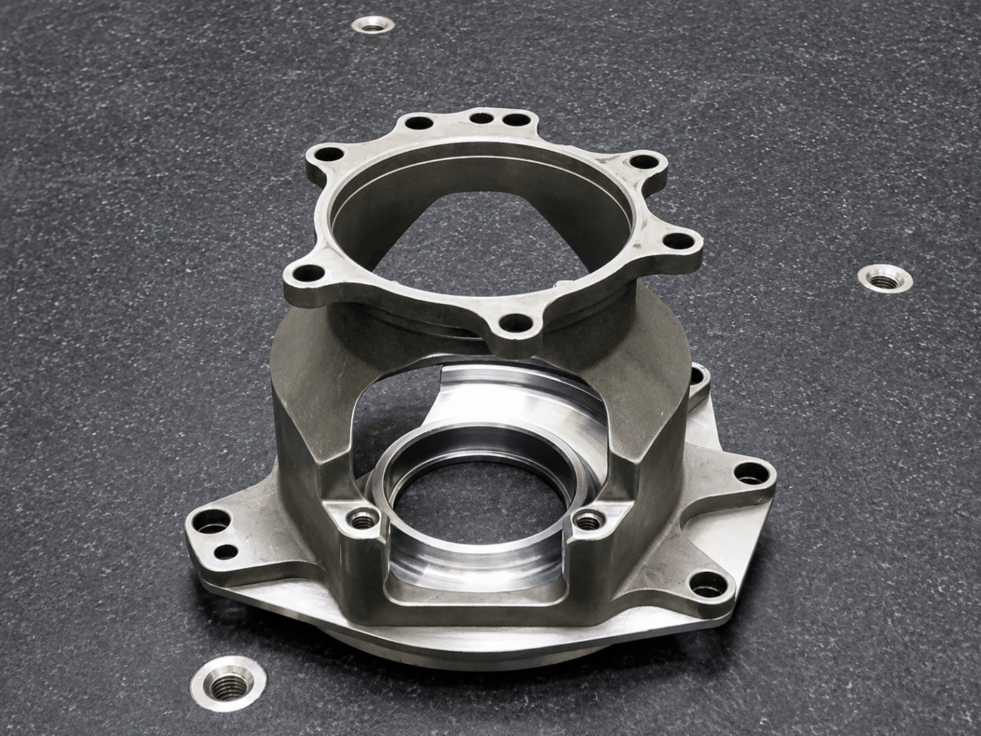
An aerospace supplier required urgent MRO of a titanium aircraft transmission housing during an Aircraft on Ground (AOG) event. The component, already in service, needed to be restored to exact specifications rather than remanufactured from scratch, with zero tolerance for error. The repair process involved detailed inspection, precision machining, and careful handling of titanium to maintain structural integrity and critical tolerances.
Despite compressed timelines, the team at Nyalt Precision executed the overhaul with a concentrated focus on accuracy and process control, enabling a rapid return to service. This approach eliminated the need for full replacement while minimizing downtime and preserving component performance.
In-House Engineering for Complex Part Geometries
At Nyalt, we combine precision machining with in-house engineering support to ensure every project meets strict performance and manufacturability goals. Our team works directly with clients to interpret technical specifications and improve outcomes before the first part is cut.
Technical Capabilities & Quality Assurance
DFM Review → Nyalt’s DFM approach optimizes components for production, enhances quality, and improves cost-effectiveness. Client designs are reviewed before machining begins to identify and resolve manufacturability issues.
CAD/CAM Programming → Mastercam handles 2D and 3D machining, while Siemens NX covers advanced 5-axis programming. Okuma Sampling Path control provides a real 3D simulation to verify operations before cutting begins.
Complex Geometry Capability → Intricate 3D contoured shapes, superior surface finishes, and components with challenging roundness specifications are all within scope. Projects that exceed the capabilities of other facilities are a regular part of our work.
IP Protection → Comprehensive data protection protocols safeguard client confidentiality from initial consultation through final delivery. All CAD files, specifications, and program data are protected throughout the project lifecycle, and Nyalt Precision goes to great lengths to protect all intellectual property from unauthorized access.
Certifications → We are AS9100 and ISO 9001-certified and enforce standardized process controls. These measures guarantee consistent results across every manufacturing batch.
FAQs: Aerospace Titanium Machining Services
Q: What types of titanium and other hard-to-machine alloys do you work with?
A: Nyalt machines a wide range of aerospace-grade titanium and other heat-resistant superalloys (HRSA) like Inconel and Rene 77 that require specialized cutting strategies.
Q: Do you handle post-processing and finishing for titanium parts?
A: We manage the entire manufacturing workflow, including heat treating, plating, and finishing services to deliver fully completed components.
Q: What secondary services does Nyalt offer?
A: Our facility specializes in a wide range of value-added services, including low-volume production runs, and efficiently handles complex prototypes and small-batch orders with quick turnaround times.
Choose Nyalt For Precision Aerospace Titanium Machining
Titanium is one of the most difficult materials to machine and frequently causes schedule delays when suppliers lack the specific equipment to handle its elasticity. At Nyalt, our team leverages decades of experience with high-temp superalloys to deliver defect-free hardware for the global space industry. Contact us below for a quote and to learn more about our capabilities.
Need more Info? Click one of the links.
