
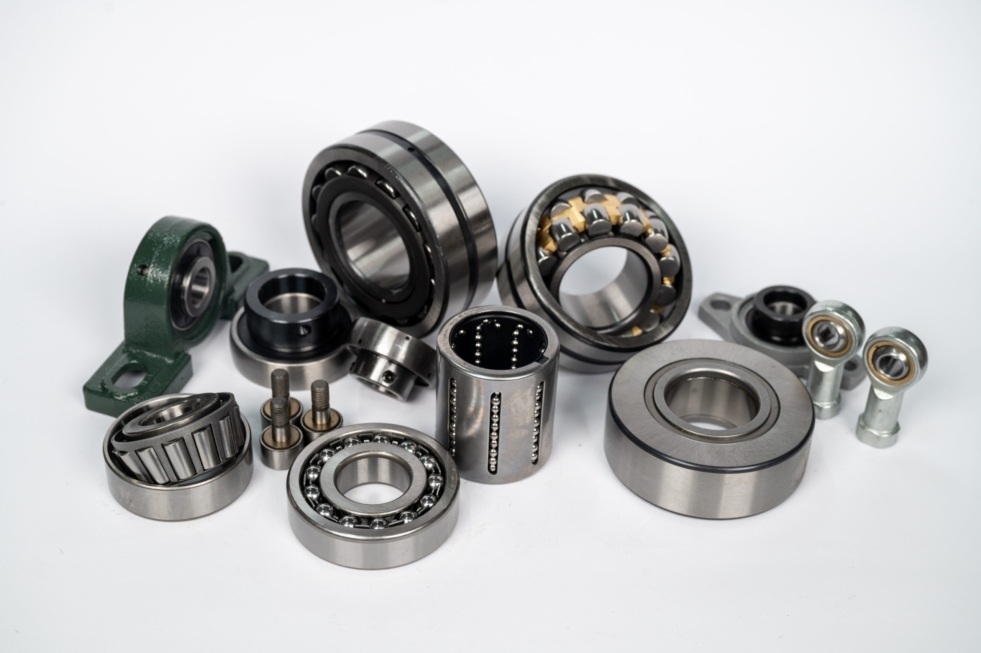
Custom bearing components leave little room for dimensional mismatch between the ball, race, and liner. One small error in dimensional accuracy, tolerances, or consistency can lead to complete assembly failure during operation. Finding a machine shop with the equipment and experience for start-to-finish bearing machining projects can be difficult.
At Nyalt, we manage precision bearing machining as one connected production process. Our control over each stage supports consistent fit and quality throughout the production batch.
Read on to learn more about our process for custom bearing components and assemblies, or contact our team today to get started.
Get a Quote for Precision Bearing Machining
What Makes Bearing Machining Different From General CNC Machining?
General CNC components may include features that can be inspected independently against the customer drawing. A spherical plain bearing places greater emphasis on the ball, race, and liner because their mating surfaces form one working geometry inside the assembly. Machining and inspection must therefore control the specified relationships among the components as well as each feature.
Hardened stainless steel makes those relationships more difficult to hold because the material wears cutting tools faster. Process planning must account for the material condition, heat-treatment distortion, and enough stock for final finishing. Grinding typically establishes the final geometry on these hardened surfaces when turning or milling alone cannot hold the required dimensions and form.
Production planning must account for the individual components, the completed assembly, and the full batch:
- Mating spherical surfaces: The ball and race must conform to the customer-specified mating geometry.
- A multi-component system: Together, the ball, race, and liner form a complete bearing assembly.
- Geometry as well as size: Roundness and centerline relationships require control alongside individual diameters.
- Performance in operation: Functional verification determines whether the completed bearing operates as specified because dimensional reports alone cannot provide that result.
- Batch consistency: Stable setups and consistent tool control reproduce the required geometry throughout the production run.
Machining and Grinding Hardened Bearing Components
Hardened stainless steel changes the order in which bearing components are machined. Alloys such as 17-4 PH cause faster cutting-tool wear after heat treatment, so turning and milling remove most of the stock while the material remains softer. The machining sequence leaves enough stock for correction and final grinding after hardening.
Heat treatment can distort the ball and race, so the grinding allowance provides material for correction. After the parts return, we use OD and ID grinding to produce the dimensions required before assembly or the next specified operation. Nyalt coordinates heat treatment and the chrome plating required by the marine project through approved external providers; neither operation is performed in-house.
Why Tight Tolerances Matter in Bearing Manufacturing
Small dimensional changes can alter how a spherical plain bearing fits, carries load, and articulates. Bore and OD dimensions determine the fit with the pin and housing, while spherical form and liner compression affect load distribution and repeatable movement. The tightest tolerances on our marine assembly were ±0.00025 inch (approximately 0.006 mm), so a 0.001-inch deviation from nominal would have exceeded that limit by a factor of four.
On qualifying parts, our CNC equipment can hold tolerances to ±0.0002 inch (5 microns), while our grinding equipment can reach ±0.00008 inch (2 microns). We use Renishaw Primo Twin probes to measure tools and workpieces during machining, and the controller updates offsets without removing the part from its fixture. CMM inspection provides a separate check on finished dimensions and helps us detect dimensional drift during the production batch.
| Bearing Feature | Why Precision Matters | Result of Minor Errors |
| Bore & OD | Controls the fit between the bearing, pin, and housing | Too loose creates movement and fretting; too tight can interfere with assembly or operation |
| Spherical Geometry | Keeps loads distributed evenly across the bearing surface | Minor form errors can concentrate loads and accelerate localized wear |
| Surface Finish | Influences friction and breakaway torque at the liner | Rough or inconsistent surfaces can increase torque and shorten liner life |
| Internal Clearance / Preload | Determines how freely and consistently the bearing articulates | Too much clearance creates play; too little can restrict movement |
Balancing Load Capacity, Fit, and Rotational Performance
Radial static load capacity and no-load rotational breakaway torque pull against each other in a spherical plain bearing. Broader contact distributes radial load, while additional preload raises the torque needed to start rotation. We hold the specified fit among the ball, liner, and race, and the liner’s material and compression set the friction at the sliding surface.
Marine steering linkages, pivot joints, and cylinder rod ends are typical assemblies that support radial loads and articulate through a limited angle. These joints need controlled articulation rather than continuous high-speed rotation, so added friction can interfere with their intended motion. We treat load capacity, fit, and breakaway torque as linked assembly requirements rather than separate machining targets.
Custom Spherical Bearing Machining for Specialized Applications
We produce custom spherical plain bearing components from customers’ specifications rather than supply standard catalog bearings. Size, material, hardness, liner, tolerance, and specified load and torque requirements determine how we machine and finish the ball and race. One customer program can include multiple versions, with the drawing package defining the geometry of each.
A marine customer ordered custom spherical plain bearing assemblies in several sizes. Every version belonged to the same production program and followed the dimensions specified for that size. We carried those specifications through machining, grinding, and final assembly.
Case Study: Spherical Bearing Assembly for Marine Environments
Recently, a marine industry customer required a batch of 150 custom spherical bearing assemblies that could withstand high radial static loads while also maintaining a specified no-load rotational breakaway torque. This assembly project presented several challenges, including the 440C stainless steel materials that required heat treatment to 54-58 HRc before undergoing chrome plating.
The primary machining challenge for these bearing assemblies centered on the extremely precise dimensions required, with precision tolerances as tight as ±0.00025 inch (0.006 mm). This left little room for any variation that could impact fit, load distribution, articulation, or final performance.
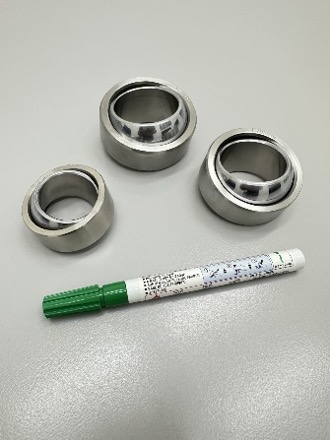
Several assembly sizes are shown beside a marker for scale. The visible chrome-plated 440C balls are seated inside 17-4 PH stainless steel races.
By tightly controlling the bearing dimensions and material conditions throughout the production cycle, we were able to produce the full volume of 150 assemblies to exact customer specifications. This project required an exceptional level of machining precision and equipment to meet the spherical tolerances and consistency in marine-based bearings.
Precision CNC Machining for Custom Bearing Components
Nyalt machines custom bearing components and assemblies from prototypes through production batches. We perform CNC machining, precision grinding, and assembly in the same facility.
This setup reduces the handling and dimensional variation that can occur between shops and lets you combine the following work under one order:
- CNC turning and multi-axis milling: These processes support balls, races, housings, and related components, with tolerances to ±0.0002 inch on qualifying features.
- Precision grinding: We provide surface, cylindrical, OD, ID, form, and centerless grinding, including post-heat-treatment work, with tolerances as tight as 0.00008 inch on qualifying parts.
- Full part assembly: Machined components are assembled to your bill of materials and delivered as finished bearing assemblies.
- Certified quality system: We have held ISO 9001 certification since 2005 and AS9100 certification since 2010.
- Prototype-to-production capacity: Project volume can range from a single prototype or one-off component to a full production run.
Send us your drawings, material specifications, quantity, and load and torque requirements for review. We will use those specifications to determine the machining sequence, grinding method, and assembly scope.
Partner With Nyalt for Precision Bearing Machining
Precision bearing machining for custom components and assemblies requires consistent control of every mating part. The completed bearing must meet the specified dimensions and perform as one unit.
Nyalt produces custom bearing components and finished assemblies from customer drawings. Our combined machining, grinding, and assembly work reduces handoffs and keeps responsibility with one shop.
Need more Info? Click one of the links.
